America is the king kong of markets and dwarfs the rest of the planet. It is the only game in town for scaled upward mobility.
Everywhere you look, someone is calling for the next big American crash.
The Big Short and Margin Call became popular. Everybody wants to be Michael Burry now.
I've caught myself doing it too. People keep pointing at the 1970s, 1999, and 2008 as premonitions as if the market will crash.
I don't think it will anytime soon.
The U.S. has firewalls now — political, legal, and economic — built to stop the worst from happening. A lot of the old, broken code got patched.
Most people just chant "never bet against America." Fine platitude.
I think it's worth mentioning the reasons why or the guard rails of why things are they way they are in the USA.
1. America Pays the Rich to Build
You're incentivized to invest in America and develop it as a wealthy person.
In the U.S., if you put money into real businesses, real estate, or new ideas, the tax code rewards you hard. Done right, your real tax rate can drop under 10%.
A few of the tools — and when each one showed up:
1031 Exchange (1921; renamed Section 1031 in 1954) — Sell a property, buy another, and push the tax bill down the road.
QSBS (1993) — Back a small company, hold the stock five years, and pay little or no tax on the gain.
Opportunity Zones (2017) — Invest in certain neighborhoods, get a tax break.
REPS (1993, in effect 1994) — If real estate is your actual job, you can write off a lot.
Eminent Domain pay (1791) — Built into the Constitution's Fifth Amendment: if the government takes your land, it has to pay you fairly.
Clean inheritance (1770s–1780s) — After the Revolution, states scrapped the old rules that locked estates up. Land passes down whole — we don't chop it into useless slivers like some countries do.
A land title system that works (colonial era, 1600s) — Public records of who owns what go back to the early colonies. You can prove ownership. (Half the planet still can't.)
Private ownership tools (land trusts, 1800s; LLCs, 1977) — Hold property through a trust or company without your name plastered everywhere.
Roughly once a generation, America adds a new tool that pulls money off the sidelines and into building things.
2. Easy to Hire, Easy to Fire
American companies can hire fast and let people go fast. Almost nowhere else on Earth works this way. A quick world tour of what firing one underperformer actually costs:
Europe:
Germany — Once you pass 10 employees, dismissal-protection law kicks in. You often need a "socially justified" reason, and the works council gets a say before you act.
France — Fired workers can drag you into special labor courts (the prud'hommes). Cases take years. Many firms just pay people to leave.
Spain — Unfair dismissal can cost up to 33 days of pay per year worked. Fire a 10-year employee, write a check for nearly a year's salary.
Italy — For decades, courts could force you to re-hire someone you fired. Companies stayed tiny on purpose to dodge the rules.
Asia:
Japan — Courts void dismissals that lack "objectively reasonable grounds." In practice, firing a full-time employee is close to impossible. Companies park dead weight in "window seat" jobs instead.
India — Factories with 100+ workers have historically needed government permission to lay people off. Read that again: permission.
China — After two fixed-term contracts, workers get an open-ended one. Severance is roughly a month's pay per year served.
South Korea — "Just cause" required, and a labor commission can order reinstatement with back pay.
Latin America:
Brazil — The CLT labor code is from 1943. Fire someone without cause and you owe a 40% penalty on their savings fund. Brazil's labor courts handle millions of lawsuits a year.
Mexico — Unjustified dismissal = three months' salary plus 20 days per year worked, minimum.
Argentina — Severance is heavy, and during crises the government has literally doubled it by decree to freeze layoffs.
Why is everyone else like this? Payroll taxes are the most reliable paycheck those governments get. They hate anything that rocks that boat, so they make firing painful on purpose.
The result: their workforce gets stuck in place.
Ours moves. And businesses that can move fast get stronger.
3. You Get More Than One Shot
Fail in America and you can come back. That's rare on Earth.
Bankruptcy:
USA — Chapter 11 lets a struggling company keep operating while it fixes its debts. Chapter 7 wipes a person's slate in months. Founders fail, file, and start company #2 next year. Investors shrug, no biggie. Get back up Rocky!
Europe — Germany made bankrupt individuals wait six years for debt forgiveness (only recently cut to three). The social stigma can outlast the paperwork.
Japan — Banks routinely demand personal guarantees from founders. Company dies, founder's life savings die with it. People avoid starting companies at all.
China — There is still no nationwide personal bankruptcy law. Shenzhen ran the country's first pilot in 2021.
India — Didn't have a real modern bankruptcy code until 2016. Cases still crawl.
Brazil — "Judicial recovery" exists, but it grinds through courts for years. Brazil is one of if not the most litigious countries on the planet.
Credit:
USA — Your score is a number, not permanent blemish. Bad marks fall off after about seven years. You can rebuild starting tomorrow.
Much of the world — Thin records or outright blacklists. A default can follow you indefinitely, and there's no clear ladder back.
Courts:
USA — Contracts get enforced, fast and predictably. Delaware's business court is so respected that companies worldwide choose American law for their deals.
India — Enforcing a simple contract through court has averaged close to four years.
Italy — Commercial cases routinely run past three years.
Brazil — Endless appeals; "final" rulings take years to actually become final.
In America, falling down isn't the end.
You can wrangle and fight back.
Every other country is a guillotine via paperwork and anxiety.
4. The Grown-Ups Are Watching the Money
I'm the first person to make fun of coastal elite bullshittery — but it's a cartel rigged in your favor if you own the markets.
The biggest money managers and the Federal Reserve talk constantly.
Daily standups for the nation's cash.
Protecting retirement and pension money is serious — like national security for your 401(k).
You might not see it if you're not in the coastal elite montauk trustwad money world, but it's there, and every extreme risk gets checked, then checked again, before it can touch grandma's pension.
I mock the coastal elite montauk trustwad class endlessly but I also own the assets.
5. The Game Is Hedged in Our Favor
America galvanizes investors every decade. I knew a guy who had a webcam pointed at the twin towers on 9/11 - he shorted the markets - and would have made hundreds of millions - but the market forces and gov't opted to not pay him. Tied him up in courts for years. The US system is rigged fully - but in your favor in the long run.
1980s — After insider-trading scandals, Congress cranked penalties way up (1988). After the 1987 crash, exchanges added "circuit breakers" that pause trading before panic snowballs.
1990s — New laws (1995, 1996) cut down junk lawsuits against companies and streamlined the rules, making it cheaper to be a public company and safer to hold one.
2000s — After Enron, Sarbanes-Oxley (2002) made CEOs personally sign off on their numbers — lie and you can go to prison. The Pension Protection Act (2006) let employers auto-enroll workers into 401(k)s.
2010s — After 2008, Dodd-Frank (2010) forced big banks to pass yearly stress tests. The JOBS Act (2012) opened private markets to more investors, with rules.
2020s — The SECURE Acts (2019, 2022) push retirement saving even harder: most new 401(k) plans must now auto-enroll employees by default.
Auto-enrollment means every two weeks, tens of millions of paychecks buy stocks automatically — no decision, no hesitation, no panic-selling. American retirement accounts now hold roughly $49 trillion: about $10 trillion in 401(k)s, $19 trillion in IRAs, and $10 trillion in government pensions. A huge slice of that rotates into U.S. markets every single payday, in any weather.
It's a permanent bid under the market that no other country has built.
Now add the AI layer. Quick lesson: Goodhart's Law says once a number becomes the target, people start gaming it, so the number stops telling the truth.
My add-on: that law has a half-life. It decays fast now with AI and our matrix multiplication gods in full flow.
AI lets the big players hedge against every visible warning sign — faster every single year. If you can spot a red flag on the internet, the smart money already saw it and already bet around it. About half of all U.S. market dollars are institutional. That's a giant octopus quietly steering the swamp — fed by a permanent river of retirement money, armored by forty years of law, and getting smarter every year. (The data feeds powering this kind of watching — things like twitterapi.io and newsdata.io — are cheap and everywhere now.)
6. The World's Switzerland
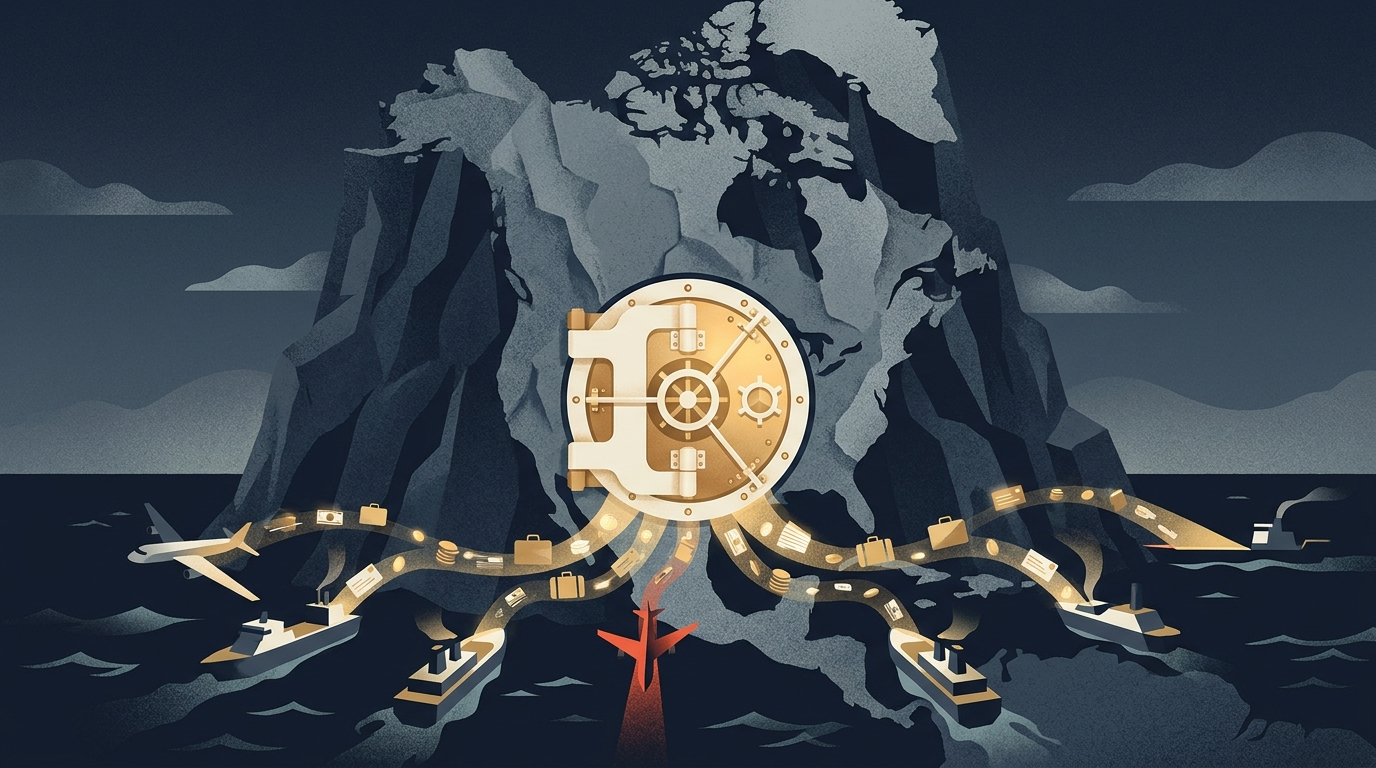
America is the world's favorite place to park money — including money that doesn't want to be seen.
Foreign investors hold trillions in U.S. assets, and the U.S. pulls in more foreign direct investment than any country on Earth. Part of that is our strength. But part of it is privacy:
A Delaware or Wyoming LLC can hold property without telling the world who's behind it.
South Dakota trusts shield fortunes for generations.
The U.S. never signed the global bank-information-sharing standard that it forces on everyone else. We demand the world's data; we don't hand back ours.
Watchdog groups now rank the United States — not Switzerland — as the #1 financial secrecy haven on the planet.
And dirty money does get through. Real example: a Chinese-Mexican businessman tied to meth-chemical trafficking wired tens of millions into a famous Las Vegas casino in the mid-2000s. Nobody flagged it until Mexican police found $207 million in cash at his house — the biggest cash seizure in history. The casino's parent company later paid $47 million to settle and avoid prosecution.
You're to believe that folks like Miriam Adelson don't clean dirty narco cash to finance a foreign country's intelligence operations. Yeah, that makes sense. That's why the traffic numbers to those casinos go up even though travel to Vegas has declined. Yes of course that makes sense.
The Bottom Line
Second place to America isn't close. It's a blip and far away.
Tax rules, labor freedom, second chances, money watchmen, the every-decade galvanizing amor, the $49 trillion retirement river, and the vault-door privacy pulling in the world's capital — keeps absorbing the shocks.
If you're going to bet against America - you are likely bold and betting with other peoples' money and not your own.